
Polyurethane drum screen, low noise and smooth operation

How does trommel screen work?


The trommel screen is connected by the motor through the reducer and the roller device through the coupling and drives the roller device to rotate about its axis. Through the variable speed deceleration system, the screening cylinder is rotated at a certain rotation speed, and the material is separated from the top to the bottom through the screening cylinder, the fine material is discharged from the lower part of the front end of the drum screen, and the coarse material is discharged from the lower end of the screening cylinder. Due to the turning and rolling of the material in the drum, the material stuck in the screen hole can be ejected to prevent the screen hole from being clogged. During the use of the drum screen, the operation is slow and uniform, the impact vibration is small, the work is stable, the installation is simple, and no special foundation is needed. The installation angle is small and it is not easy to block. It can be placed directly on a flat floor or floor and under the silo. The machine is easy to close and collect dust, has small maintenance, simple maintenance and long service life.
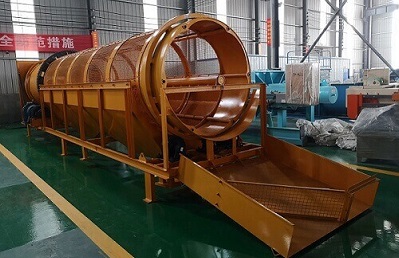
   

Features


1. The installation angle is small and it is not easy to block;
2, occupying a small space;
3. Low noise and less dust pollution;
4, smooth operation;
5. High screening efficiency;
6. Adopting the principle of rolling conveying, the friction coefficient is small, the wear is light, and the mesh hole is not easy to block.
7. The equipment has low noise. During the operation of the rotary screen, the rotation speed is small, and the sealed isolation cover is isolated from the outside, so that the noise cannot be transmitted to the outside, thereby reducing the noise of the equipment.

Trommel screen application


Scope of drum screening machine: The trommel screen is mainly used for classifying the particle size of materials, and is widely used in electric power, mining, metallurgy, building materials, chemical and other production industries. It is often used for the classification of refractory materials, coal, fertilizer, sand field stones, as well as the screening of sticky materials such as coal, coke, white ash, gold deposits, etc., to make the product structure more even to meet the production needs.

Comments

Popular posts from this blog

River Water Cyclone Desander

 A cyclone desander is a sand removal device that combines cyclone flow and filtration. It is primarily used to remove solid particles and sediment from groundwater, including groundwater and other water sources. It is suitable for water-source heat pump systems, central air conditioning circulating cooling water, chilled water systems, winter heating and cooling circulating water systems, and industrial cooling circulating water systems. It is widely used in many industries, including the chemical, environmental protection, and food industries, achieving remarkable results in water treatment, including sand removal, turbidity reduction, solid-liquid separation, and sediment separation. Cyclone Desander Concept: A cyclone desander, also known as a cyclone desander or desander, is a device that uses the principle of screening solid particles in the medium as they rotate within the desander. Combining cyclone flow and filtration, it achieves remarkable results in water treatment, in...

Water-Saving Sand Washing Plant

Choosing water-saving equipment and integrating recycling functions is the key to fundamentally reducing water consumption. Select advanced sand washing equipment Bucket-type sand washing machine: The structure is simple, with almost no wearables except for the screen, and the failure rate is low. It adopts a circulating water cleaning method and is one of the relatively more water-efficient mainstream choices currently. Integrated sand washing equipment: This type of equipment integrates sand washing, fine sand recycling, dehydration, and even wastewater treatment functions into one, significantly simplifying the process flow. For example, some new equipment uses built-in bubble flushing technology to improve the flushing effect and avoid secondary cleaning waste caused by incomplete cleaning. Mandatory water recycling system Modern sand washing equipment usually comes with a water recycling system, which can collect, filter, and reuse water during the cleaning cycle. This approach ca...

The difference between quartz and mica

Mica and quartz are common minerals that play an important role in mineralogy. Although they are both silicate minerals, there are clear differences between them. First, mica and quartz are very different in appearance. One of its distinguishing features is that mica exhibits a layered structure that can be easily peeled off into thin flakes. Quartz, on the other hand, is a uniform crystal with no layered structure. Additionally, mica is usually dark in color, such as black, brown, or green, while quartz is usually clear or white. Secondly, mica and quartz also differ in their physical and chemical properties. The hardness of mica is usually between 2.5 and 4, which is relatively easy to be scratched; while the hardness of quartz is very high, 7, which is a very hard mineral. In addition, mica has good refractive properties and electrical properties, while quartz is an excellent piezoelectric material.