
The working principle of the Hydraulic desilter

The hydraulic desilter has a mud cyclone desander, which first pumps the mud into a funnel container by a sand pump. The pumping direction is directed along the tangential line to the inner wall of the container. The slurry is rotated by centrifugation, the structure is destroyed, the cuttings and sand are discharged from the funnel, and the mud flows out from the upper opening of the container. The mud cyclone desander has better sand removal effect than the vibrating screen and is widely used in deep well drilling.
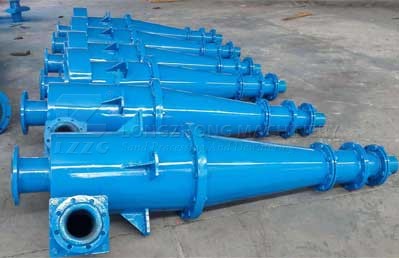
hydrocyclone
hydro-cyclones

The cyclone desander is based on the principle of centrifugal sedimentation and density difference. When the water flows from the sand removal inlet to the equipment in a tangential direction under a certain pressure, a strong rotary motion is generated. Due to the different density of sand and water, the centrifugal force, Under the combined action of centripetal force, buoyancy and fluid drag, the low-density water is lifted and discharged from the water outlet, and the dense sand is discharged from the sewage outlet at the bottom of the equipment to achieve the purpose of sand removal.
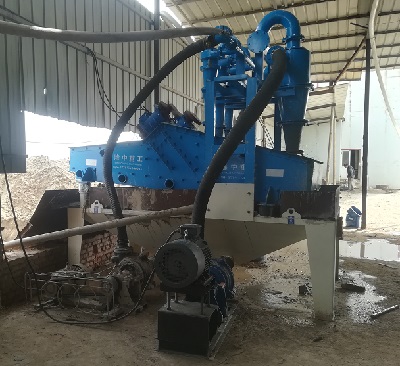
find sand recycling machine working principle
mud cleaner machine

Desander process: raw water - swirling sand removal - precision filtration - storage tank - user cyclone desander is based on the principle of centrifugal sedimentation and density difference, when the water flow is under a certain pressure, from the sander inlet to cut After entering the equipment, a strong rotational motion is generated. Due to the different sand water density, the centrifugal force, the centripetal buoyancy, and the fluid drag force are different due to the force, so that the low-density clear water rises and is discharged from the overflow port. The large sand is discharged from the bottom discharge port to achieve the purpose of sand removal. Under certain ranges and conditions, the greater the water inlet pressure of the desander, the higher the sand removal rate, and multiple units can be used in parallel.

When selecting the type of desilter, the desilter should allow a maximum of 1.25 times the maximum displacement of the drilling fluid. The drilling fluid entering the desilter does not have to be treated by a vibrating screen or a desander.

Comments

Popular posts from this blog

The classifications of quartz sand

  1. Ordinary quartz sand: The surface of ordinary quartz sand seems to have a layer of yellow skin, and some have large particles and strong fire resistance. It is a kind of quartz sand processed by the manufacturer after using natural quartz ore in the production process, such as washing and drying. No impurities can be seen in the quartz sand through the second water treatment filtration. It is the best choice for chemical water treatment. It can block the sundries suspended in the water and maintain the quality and beauty of the water. 2. Refined quartz sand: Refined quartz sand is a mineral made by the manufacturer after carefully selected quartz stone. According to different requirements of users, the range used is also different. But generally the main use of refined quartz sand is in glass products, because refined quartz sand is refractory and precision casting, especially suitable for fireproof glass materials.

Chromite purification processing method

At present, chromium ores with industrial value are generally chromium-magnesia spinel or chromium-iron spinel minerals, which contain a large amount of chromium oxide, with a content of about 18% to 62%, and generally also contain metals such as aluminum and nickel. Its characteristics make the chromium ore beneficiation process present a rich and diverse state. Due to the properties of chromium, chromium ore beneficiation processes include gravity separation, magnetic separation, flotation, combined beneficiation, chemical beneficiation, etc. Commonly used in industry are single gravity separation, single magnetic separation, and gravity-magnetic combined beneficiation processes. In terms of equipment selection, shakers and jigs are mostly used in the gravity separation stage, while the equipment selection in the magnetic separation stage is determined based on the magnetism of the ore.

Sandblasting nozzle classification and use

Using high-pressure air as a power source to drive abrasive particles to hit objects within a certain range will produce a great impact. The function of the sandblasting nozzle is to spray abrasive particles on the object evenly and efficiently. Sandblasting nozzles can be divided into: straight hole sandblasting nozzle, Venturi sandblasting nozzle , double Venturi sandblasting nozzle, angle sandblasting nozzle Straight hole nozzle: There are only contraction section and straight section inside, the structure is simple and easy to manufacture. This kind of nozzle cannot overcome the vortex phenomenon existing at the inlet end, and the pressure loss is large; the abrasive velocity at the outlet is less than 100m/s under the pressure of 0.7MPa.